Art World New Rules Of The Game Pdf Free Download

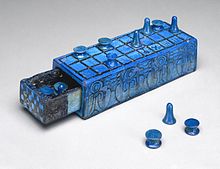
Aboriginal Egyptian gaming board inscribed for Amenhotep III with separate sliding drawer, from 1390 to 1353 BC, made of glazed faience, dimensions: 5.5 × 7.7 × 21 cm, in the Brooklyn Museum (New York City)

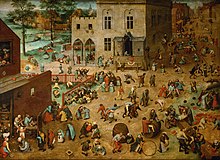


A game is a structured form of play, usually undertaken for amusement or fun, and sometimes used equally an educational tool.[1] Games are different from work, which is usually carried out for remuneration, and from art, which is more often an expression of aesthetic or ideological elements. Even so, the stardom is non lucent, and many games are also considered to be piece of work (such as professional players of spectator sports or games) or art (such as jigsaw puzzles or games involving an artistic layout such as Mahjong, solitaire, or some video games).
Games are sometimes played purely for enjoyment, sometimes for achievement or reward also. They can be played alone, in teams, or online; by amateurs or by professionals. The players may have an audience of non-players, such equally when people are entertained by watching a chess championship. On the other manus, players in a game may constitute their ain audience as they take their plough to play. Often, part of the entertainment for children playing a game is deciding who is part of their audience and who is a thespian. A toy and a game are not the same. Toys by and large permit for unrestricted play whereas games come with present rules.
Key components of games are goals, rules, challenge, and interaction. Games generally involve mental or physical stimulation, and often both. Many games help develop applied skills, serve as a form of exercise, or otherwise perform an educational, simulational, or psychological role.
Attested as early equally 2600 BC,[2] [3] games are a universal office of human experience and present in all cultures. The Regal Game of Ur, Senet, and Mancala are some of the oldest known games.[four]
Definitions
 | Await upwards game in Wiktionary, the free lexicon. |
Ludwig Wittgenstein
Ludwig Wittgenstein was probably the outset academic philosopher to address the definition of the word game. In his Philosophical Investigations,[5] Wittgenstein argued that the elements of games, such as play, rules, and competition, all neglect to adequately define what games are. From this, Wittgenstein ended that people apply the term game to a range of disparate human activities that acquit to 1 another only what ane might phone call family resemblances. As the post-obit game definitions evidence, this conclusion was not a final ane and today many philosophers, like Thomas Hurka, think that Wittgenstein was incorrect and that Bernard Suits' definition is a good reply to the trouble.[vi]
Roger Caillois
French sociologist Roger Caillois, in his book Les jeux et les hommes (Games and Men)(1961),[vii] divers a game equally an activity that must have the following characteristics:
- fun: the activity is chosen for its lite-hearted grapheme
- split up: it is circumscribed in time and place
- uncertain: the outcome of the activity is unforeseeable
- non-productive: participation does not accomplish anything useful
- governed by rules: the activity has rules that are different from everyday life
- fictitious: it is accompanied by the awareness of a dissimilar reality
Chris Crawford
Game designer Chris Crawford divers the term in the context of computers.[8] using a serial of dichotomies:
- Creative expression is fine art if fabricated for its own beauty, and entertainment if fabricated for money.
- A piece of entertainment is a plaything if it is interactive. Movies and books are cited as examples of non-interactive entertainment.
- If no goals are associated with a plaything, it is a toy. (Crawford notes that by his definition, (a) a toy can become a game element if the thespian makes upwardly rules, and (b) The Sims and SimCity are toys, not games.) If it has goals, a plaything is a challenge.
- If a challenge has no "active agent against whom yous compete", it is a puzzle; if there is one, it is a conflict. (Crawford admits that this is a subjective test. Video games with noticeably algorithmic artificial intelligence can be played every bit puzzles; these include the patterns used to evade ghosts in Pac-Human.)
- Finally, if the actor tin can only outperform the opponent, merely not assail them to interfere with their operation, the conflict is a competition. (Competitions include racing and figure skating.) Still, if attacks are allowed, and so the disharmonize qualifies as a game.
Crawford's definition may thus exist rendered as[ original research? ]: an interactive, goal-oriented activity made for money, with active agents to play against, in which players (including active agents) can interfere with each other.
Other definitions, nevertheless, besides every bit history, show that entertainment and games are not necessarily undertaken for monetary gain.
Other definitions
- "A game is a form of art in which participants, termed players, make decisions in order to manage resource through game tokens in the pursuit of a goal." (Greg Costikyan)[nine] According to this definition, some "games" that do not involve choices, such as Chutes and Ladders, Candy Country, and War are not technically games any more than a slot motorcar is.
- "A game is a form of play with goals and structure." (Kevin J. Maroney)[x]
- "A game is a system in which players engage in an bogus conflict, defined past rules, that results in a quantifiable issue." (Katie Salen and Eric Zimmerman)[xi]
- "A game is an activity among two or more than independent conclusion-makers seeking to accomplish their objectives in some limiting context." (Clark C. Abt)[12]
- "At its almost unproblematic level then we tin ascertain game every bit an exercise of voluntary control systems in which there is an opposition between forces, confined past a procedure and rules in order to produce a disequilibrial outcome." (Elliot Avedon and Brian Sutton-Smith)[13]
- "to play a game is to engage in activeness directed toward bringing about a specific situation, using only means permitted by specific rules, where the means permitted by the rules are more limited in scope than they would be in the absence of the rules, and where the sole reason for accepting such limitation is to make possible such activity." (Bernard Suits)[xiv]
- "When you strip abroad the genre differences and the technological complexities, all games share iv defining traits: a goal, rules, a feedback system, and voluntary participation." (Jane McGonigal)[15]
Gameplay elements and classification
Games tin can be characterized past "what the thespian does".[viii] This is often referred to as gameplay. Major fundamental elements identified in this context are tools and rules that define the overall context of game.
Tools

Games are often classified by the components required to play them (e.g. miniatures, a ball, cards, a board and pieces, or a computer). In places where the use of leather is well-established, the brawl has been a popular game slice throughout recorded history, resulting in a worldwide popularity of brawl games such equally rugby, basketball game, soccer (football), cricket, lawn tennis, and volleyball. Other tools are more idiosyncratic to a certain region. Many countries in Europe, for case, take unique standard decks of playing cards. Other games such as chess may be traced primarily through the development and evolution of its game pieces.
Many game tools are tokens, meant to represent other things. A token may exist a pawn on a board, play money, or an intangible item such as a signal scored.
Games such equally hide-and-seek or tag do not use any obvious tool; rather, their interactivity is defined past the environment. Games with the same or like rules may have different gameplay if the surroundings is altered. For case, hide-and-seek in a school building differs from the aforementioned game in a park; an auto race can be radically unlike depending on the track or street course, even with the same cars.
Rules and aims
Games are ofttimes characterized by their tools and rules. While rules are discipline to variations and changes, enough change in the rules usually results in a "new" game. For case, baseball tin can be played with "real" baseballs or with wiffleballs. However, if the players make up one's mind to play with only three bases, they are arguably playing a different game. There are exceptions to this in that some games deliberately involve the changing of their ain rules, merely even then at that place are oft immutable meta-rules.
Rules mostly determine the time-keeping organisation, the rights and responsibilities of the players, scoring techniques, preset boundaries, and each histrion'southward goals.
The rules of a game may exist distinguished from its aims.[sixteen] [17] For well-nigh competitive games, the ultimate aim is winning: in this sense, checkmate is the aim of chess.[18] Common win conditions are being kickoff to amass a sure quota of points or tokens (every bit in Settlers of Catan), having the greatest number of tokens at the finish of the game (equally in Monopoly), or some relationship of i'southward game tokens to those of i's opponent (equally in chess's checkmate). There may also be intermediate aims, which are tasks that move a player toward winning. For instance, an intermediate aim in football is to score goals, considering scoring goals volition increase one's likelihood of winning the game, only isn't lone sufficient to win the game.
An aim identifies a Sufficient Condition for successful activity, whereas the dominion identifies a necessary condition for permissible activity.[17] For instance, the aim of chess is to checkmate, merely although it is expected that players will attempt to checkmate each other, it is not a rule of chess that a actor must checkmate the other thespian whenever possible. Similarly, it is not a rule of football that a player must score a goal on a penalty; while it is expected the role player will try, it is not required. While meeting the aims often requires a sure degree of skill and (in some cases) luck, following the rules of a game merely requires knowledge of the rules and some careful attempt to follow them; it rarely (if always) requires luck or demanding skills.
Skill, strategy, and run a risk
A game's tools and rules volition result in its requiring skill, strategy, luck, or a combination thereof, and are classified accordingly.
Games of skill include games of physical skill, such as wrestling, tug of war, hopscotch, target shooting, and stake, and games of mental skill such as checkers and chess. Games of strategy include checkers, chess, Get, arimaa, and tic-tac-toe, and often require special equipment to play them. Games of chance include gambling games (blackjack, Mahjong, roulette, etc.), as well as snakes and ladders and rock, paper, scissors; most require equipment such equally cards or dice. However, near games contain ii or all iii of these elements. For case, American football and baseball involve both physical skill and strategy while tiddlywinks, poker, and Monopoly combine strategy and chance. Many carte and board games combine all 3; almost trick-taking games involve mental skill, strategy, and an element of chance, as do many strategic board games such as Risk, Settlers of Catan, and Carcassonne.
Single-player games
Most games require multiple players. All the same, single-histrion games are unique in respect to the type of challenges a player faces. Unlike a game with multiple players competing with or against each other to achieve the game's goal, a one-role player game is a battle solely against an element of the environment (an artificial opponent), against one's own skills, confronting time, or against hazard. Playing with a yo-yo or playing tennis confronting a wall is not generally recognized equally playing a game due to the lack of any formidable opposition. Many games described equally "single-player" may be termed really puzzles or recreations.
Multiplayer games

A multiplayer game is a game of several players who may exist contained opponents or teams. Games with many independent players are difficult to analyze formally using game theory as the players may course and switch coalitions.[19] The term "game" in this context may mean either a truthful game played for entertainment or a competitive activity describable in principle by mathematical game theory.
Game theory
John Nash proved that games with several players have a stable solution provided that coalitions between players are disallowed. Nash won the Nobel prize for economic science for this important event which extended von Neumann's theory of nix-sum games. Nash's stable solution is known as the Nash equilibrium.[20]
If cooperation betwixt players is allowed, then the game becomes more than complex; many concepts have been developed to clarify such games. While these have had some partial success in the fields of economics, politics and conflict, no skillful general theory has withal been developed.[20]
In breakthrough game theory, it has been found that the introduction of breakthrough data into multiplayer games allows a new type of equilibrium strategy non found in traditional games. The entanglement of players's choices can accept the upshot of a contract by preventing players from profiting from what is known as betrayal.[21]
Types

Tug of war is an easily organized, impromptu game that requires little equipment
Games can take a variety of forms, from competitive sports to board games and video games.
Sports
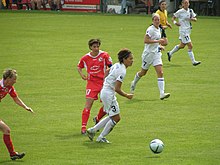
Association football is a pop sport worldwide.
Many sports crave special equipment and dedicated playing fields, leading to the involvement of a community much larger than the group of players. A metropolis or town may set aside such resources for the system of sports leagues.
Pop sports may have spectators who are entertained merely by watching games. A community will often align itself with a local sports team that supposedly represents it (even if the team or about of its players simply recently moved in); they often align themselves against their opponents or have traditional rivalries. The concept of fandom began with sports fans.
Lawn games
Lawn games are outdoor games that can be played on a lawn; an area of mowed grass (or alternately, on graded soil) generally smaller than a sports field (pitch). Variations of many games that are traditionally played on a sports field are marketed equally "lawn games" for home utilize in a front end or back yard. Common lawn games include horseshoes, sholf, croquet, bocce, and lawn bowls.
Tabletop games
A tabletop game is a game where the elements of play are confined to a small-scale area and require little physical exertion, usually just placing, picking upwards and moving game pieces. Most of these games are played at a table around which the players are seated and on which the game'south elements are located. However, many games falling into this category, particularly party games, are more complimentary-grade in their play and can involve physical activeness such as mime. Even so, these games exercise non crave a large area in which to play them, large amounts of strength or stamina, or specialized equipment other than what comes in a box.
Dexterity and coordination games
This form of games includes any game in which the skill element involved relates to manual dexterity or hand-middle coordination, but excludes the class of video games (see below). Games such equally jacks, paper football, and Jenga require only very portable or improvised equipment and tin can be played on any apartment level surface, while other examples, such as pinball, billiards, air hockey, foosball, and table hockey crave specialized tables or other self-contained modules on which the game is played. The advent of home video game systems largely replaced some of these, such as table hockey, still air hockey, billiards, pinball and foosball remain pop fixtures in private and public game rooms. These games and others, as they crave reflexes and coordination, are generally performed more poorly by intoxicated persons but are unlikely to upshot in injury because of this; as such the games are popular every bit drinking games. In addition, dedicated drinking games such equally quarters and beer pong too involve physical coordination and are pop for like reasons.
Board games
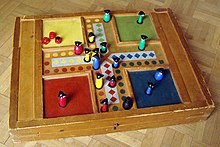
Lath games use equally a central tool a lath on which the players' status, resources, and progress are tracked using physical tokens. Many besides involve dice or cards. Most games that simulate state of war are board games (though a big number of video games have been created to simulate strategic combat), and the board may exist a map on which the players' tokens movement. Nearly all lath games involve "turn-based" play; ane actor contemplates so makes a motion, then the next role player does the aforementioned, and a player tin merely human activity on their turn. This is opposed to "real-time" play as is institute in some card games, virtually sports and most video games.
Some games, such as chess and Become, are entirely deterministic, relying only on the strategy element for their interest. Such games are usually described as having "perfect information"; the only unknown is the exact idea processes of ane's opponent, non the issue of whatever unknown upshot inherent in the game (such every bit a card draw or die roll). Children's games, on the other hand, tend to be very luck-based, with games such as Candy Land and Chutes and Ladders having near no decisions to be made. Past some definitions, such as that by Greg Costikyan, they are not games since there are no decisions to brand which affect the issue.[22] Many other games involving a high degree of luck practise non permit direct attacks between opponents; the random outcome simply determines a gain or loss in the standing of the current histrion inside the game, which is independent of whatever other histrion; the "game" then is actually a "race" by definitions such as Crawford'southward.
Most other board games combine strategy and luck factors; the game of backgammon requires players to decide the best strategic movement based on the roll of two dice. Trivia games take a great deal of randomness based on the questions a person gets. German-way board games are notable for oft having rather less of a luck factor than many lath games.
Lath game groups include race games, roll-and-move games, abstract strategy games, word games, and wargames, as well equally trivia and other elements. Some board games fall into multiple groups or incorporate elements of other genres: Attic is one popular example, where players must succeed in each of iv skills: artistry, live performance, trivia, and language.
Menu games

Carte games use a deck of cards every bit their fundamental tool. These cards may be a standard Anglo-American (52-card) deck of playing cards (such as for bridge, poker, Rummy, etc.), a regional deck using 32, 36 or 40 cards and dissimilar suit signs (such as for the popular German game skat), a tarot deck of 78 cards (used in Europe to play a multifariousness of play a joke on-taking games collectively known as Tarot, Tarock or Tarocchi games), or a deck specific to the individual game (such every bit Ready or 1000 Blank White Cards). Uno and Rook are examples of games that were originally played with a standard deck and have since been commercialized with customized decks. Some collectible card games such every bit Magic: The Gathering are played with a small-scale selection of cards that take been collected or purchased individually from large bachelor sets.
Some board games include a deck of cards as a gameplay element, normally for randomization or to keep runway of game progress. Conversely, some carte games such as Cribbage apply a board with movers, ordinarily to keep score. The differentiation betwixt the two genres in such cases depends on which element of the game is foremost in its play; a lath game using cards for random actions can usually use some other method of randomization, while Cribbage can just as hands be scored on paper. These elements as used are simply the traditional and easiest methods to achieve their purpose.
Dice games

Students using dice to ameliorate numeracy skills. They whorl 3 dice, so apply basic math operations to combine those into a new number which they cover on the board. The goal is to embrace four squares in the row.
Dice games use a number of dice as their key chemical element. Lath games often use dice for a randomization chemical element, and thus each roll of the die has a profound impact on the issue of the game, nevertheless dice games are differentiated in that the dice do not determine the success or failure of some other element of the game; they instead are the cardinal indicator of the person's standing in the game. Popular die games include Yahtzee, Farkle, Bunco, Liar's dice/Perudo, and Poker dice. As die are, past their very nature, designed to produce apparently random numbers, these games usually involve a high degree of luck, which can be directed to some extent by the player through more strategic elements of play and through tenets of probability theory. Such games are thus popular equally gambling games; the game of Craps is perhaps the most famous example, though Liar's dice and Poker die were originally conceived of as gambling games.
Domino and tile games
Domino games are similar in many respects to bill of fare games, but the generic device is instead a set of tiles called dominoes, which traditionally each have two ends, each with a given number of dots, or "pips", and each combination of two possible end values as it appears on a tile is unique in the set up. The games played with dominoes largely center effectually playing a domino from the player's "hand" onto the matching end of another domino, and the overall object could be to e'er be able to make a play, to make all open endpoints sum to a given number or multiple, or just to play all dominoes from one's mitt onto the board. Sets vary in the number of possible dots on 1 end, and thus of the number of combinations and pieces; the most common set historically is double-six, though in more recent times "extended" sets such as double-nine have been introduced to increase the number of dominoes available, which allows larger hands and more players in a game. Muggins, Mexican Railroad train, and Chicken Foot are very popular domino games. Texas 42 is a domino game more similar in its play to a "fox-taking" card game.
Variations of traditional dominoes abound: Triominoes are like in theory but are triangular and thus take three values per tile. Similarly, a game known as Quad-Ominos uses iv-sided tiles.
Some other games employ tiles in identify of cards; Rummikub is a variant of the Rummy menu game family unit that uses tiles numbered in ascending rank amidst four colors, very similar in makeup to a 2-deck "pack" of Anglo-American playing cards. Mahjong is another game very like to Rummy that uses a set of tiles with carte-like values and art.
Lastly, some games utilise graphical tiles to form a lath layout, on which other elements of the game are played. Settlers of Catan and Carcassonne are examples. In each, the "board" is fabricated up of a series of tiles; in Settlers of Catan the starting layout is random but static, while in Carcassonne the game is played by "edifice" the board tile-by-tile. Hive, an abstract strategy game using tiles every bit moving pieces, has mechanical and strategic elements like to chess, although it has no board; the pieces themselves both form the layout and tin motion within it.
Pencil and paper games
Pencil and paper games crave little or no specialized equipment other than writing materials, though some such games have been commercialized as board games (Scrabble, for instance, is based on the idea of a crossword puzzle, and tic-tac-toe sets with a boxed grid and pieces are bachelor commercially). These games vary widely, from games centering on a design being drawn such equally Pictionary and "connect-the-dots" games like sprouts, to letter and word games such as Boggle and Scattergories, to solitaire and logic puzzle games such as Sudoku and crossword puzzles.
Guessing games
A guessing game has as its cadre a piece of data that one actor knows, and the object is to coerce others into guessing that piece of information without actually divulging information technology in text or spoken give-and-take. Charades is probably the most well-known game of this type, and has spawned numerous commercial variants that involve differing rules on the type of advice to be given, such as Catch Phrase, Taboo, Pictionary, and like. The genre also includes many game shows such as Win, Lose or Draw, Password and $25,000 Pyramid.
Video games
Video games are computer- or microprocessor-controlled games. Computers can create virtual spaces for a broad diversity of game types. Some video games simulate conventional game objects like cards or dice, while others can simulate environs either grounded in reality or fantastical in pattern, each with its own gear up of rules or goals.
A computer or video game uses one or more input devices, typically a push button/joystick combination (on arcade games); a keyboard, mouse or trackball (computer games); or a controller or a motion sensitive tool (console games). More esoteric devices such equally paddle controllers have as well been used for input.
There are many genres of video game; the showtime commercial video game, Pong, was a simple simulation of tabular array tennis. As processing ability increased, new genres such as run a risk and action games were developed that involved a player guiding a character from a tertiary person perspective through a series of obstacles. This "real-time" element cannot be easily reproduced by a board game, which is generally limited to "turn-based" strategy; this reward allows video games to simulate situations such as combat more realistically. Additionally, the playing of a video game does not crave the same concrete skill, strength or danger as a real-earth representation of the game, and can provide either very realistic, exaggerated or incommunicable physics, assuasive for elements of a fantastical nature, games involving physical violence, or simulations of sports. Lastly, a reckoner tin can, with varying degrees of success, simulate one or more than human opponents in traditional table games such as chess, leading to simulations of such games that tin can be played by a single role player.
In more open up-concluded reckoner simulations, as well known as sandbox-style games, the game provides a virtual environment in which the player may be free to do whatever they like within the confines of this universe. Sometimes, there is a lack of goals or opposition, which has stirred some debate on whether these should exist considered "games" or "toys". (Crawford specifically mentions Will Wright'south SimCity every bit an example of a toy.)[8]
Online games
Online games have been part of civilization from the very earliest days of networked and time-shared computers. Early on commercial systems such every bit Plato were at least as widely famous for their games every bit for their strictly educational value. In 1958, Tennis for 2 dominated Company's 24-hour interval and drew attention to the oscilloscope at the Brookhaven National Laboratory; during the 1980s, Xerox PARC was known mainly for Maze War, which was offered as a hands-on demo to visitors.
Modern online games are played using an Internet connection; some have defended customer programs, while others require just a web browser. Some simpler browser games appeal to more than casual gaming demographic groups (notably older audiences) that otherwise play very few video games.[23]
Office-playing games
Function-playing games, ofttimes abbreviated as RPGs, are a blazon of game in which the participants (usually) presume the roles of characters acting in a fictional setting. The original role playing games – or at least those explicitly marketed as such – are played with a handful of participants, usually face up-to-face, and keep runway of the developing fiction with pen and paper. Together, the players may interact on a story involving those characters; create, develop, and "explore" the setting; or vicariously experience an hazard outside the bounds of everyday life. Pen-and-paper part-playing games include, for example, Dungeons & Dragons and GURPS.
The term role-playing game has besides been appropriated by the video game industry to describe a genre of video games. These may be unmarried-player games where 1 player experiences a programmed environment and story, or they may allow players to interact through the internet. The experience is usually quite different from traditional function-playing games. Single-role player games include Final Fantasy, Legend, The Elder Scrolls, and Mass Effect. Online multi-player games, often referred to equally Massively Multiplayer Online role playing games, or MMORPGs, include RuneScape, EverQuest 2, Club Wars, MapleStory, Chaos Online, and Dofus. As of 2009[update], the most successful MMORPG has been World of Warcraft, which controls the vast majority of the market place.[24]
Business games
Business organization games can have a diversity of forms, from interactive board games to interactive games involving unlike props (balls, ropes, hoops, etc.) and different kinds of activities. The purpose of these games is to link to some attribute of organizational performance and to generate discussions about business improvement. Many business games focus on organizational behaviors. Some of these are reckoner simulations while others are simple designs for play and debriefing. Team building is a common focus of such activities.
Simulation
The term "game" tin include simulation[25] [26] or re-enactment of various activities or use in "real life" for diverse purposes: e.yard., preparation, analysis, prediction. Well-known examples are state of war games and role-playing. The root of this meaning may originate in the human prehistory of games deduced by anthropology from observing primitive cultures, in which children's games mimic the activities of adults to a significant degree: hunting, warring, nursing, etc. These kinds of games are preserved in modernistic times.[ original research? ]
See also
 | Wikimedia Commons has media related to Game. |
- Game club
- Gamer
- Girls' games and toys
- History of games
- Learning through play
- List of games
- Ludibrium
- Ludology
- Ludomania
- Mobile game
- Northward-role player game
- Personal reckoner game
References
- ^ "Definition of GAME". world wide web.merriam-webster.com . Retrieved 7 May 2017.
- ^ Soubeyrand, Catherine (2000). "The Royal Game of Ur". The Game Cabinet. Retrieved 5 October 2008.
- ^ Greenish, William (xix June 2008). "Big Game Hunter". 2008 Summer Journey. Fourth dimension. Archived from the original on 20 June 2008. Retrieved v October 2008.
- ^ "History of Games". MacGregor Historic Games. 2006. Retrieved 5 October 2008.
- ^ Wittgenstein, Ludwig (1953). Philosophical Investigations. Oxford: Blackwell. ISBN978-0-631-23127-i.
- ^ "Was Wittgenstein Wrong Virtually Games?". Nigel Warburton. 2007. Retrieved 28 June 2013.
- ^ Caillois, Roger (1957). Les jeux et les hommes. Gallimard.
- ^ a b c Crawford, Chris (2003). Chris Crawford on Game Blueprint. New Riders. ISBN978-0-88134-117-i.
- ^ Costikyan, Greg (1994). "I Have No Words & I Must Design". Archived from the original on 12 August 2008. Retrieved 17 August 2008.
- ^ Maroney, Kevin (2001). "My Unabridged Waking Life". The Games Journal . Retrieved 17 August 2008.
- ^ Salen, Katie; Zimmerman, Eric (2003). Rules of Play: Game Design Fundamentals. MIT Press. p. 80. ISBN978-0-262-24045-one.
- ^ Clark C. Abt (1987). Serious Games. Academy Printing of America. ISBN978-0-8191-6148-2.
- ^ Avedon, Elliot; Sutton-Smith, Brian (1971). The Study of Games. J. Wiley. p. 405. ISBN978-0-471-03839-9.
- ^ Suits, Bernard (1967). "What Is a Game?". Philosophy of Science. 34 (2): 148–156. doi:ten.1086/288138. JSTOR 186102. S2CID 119699909.
- ^ McGonigal, Jane (2011). Reality is Cleaved . Penguin Books. ISBN978-0-14-312061-two.
- ^ Schwyzer, Hubert (October 1969). "Rules and Practices". The Philosophical Review. 78 (four): 451–467. doi:10.2307/2184198. ISSN 0031-8108. JSTOR 2184198.
- ^ a b Marsili, Neri (12 June 2018). "Truth and assertion: rules versus aims" (PDF). Analysis. 78 (4): 638–648. doi:10.1093/analys/any008. ISSN 0003-2638.
- ^ Kemp, Gary (2007). "Assertion equally a do". Truth and Spoken communication Acts: Studies in the Philosophy of Language.
- ^ K.G. Binmore (1994). Game Theory and the Social Contract . MIT Press. ISBN978-0-262-02444-0.
- ^ a b Laszlo Mero; Anna C. Gosi-Greguss; David Kramer (1998). Moral calculations: game theory, logic, and human frailty. New York: Copernicus. ISBN978-0-387-98419-3.
- ^ Simon C. Benjamin & Patrick M. Hayden (xiii August 2001). "Multiplayer breakthrough games". Physical Review A. 64 (3): 030301. arXiv:quant-ph/0007038. Bibcode:2001PhRvA..64c0301B. doi:ten.1103/PhysRevA.64.030301. S2CID 32056578.
- ^ Costikyan, Greg (1994). "I Take No Words & I Must Design". Archived from the original on 12 August 2008. Retrieved 17 August 2008.
- ^ De Schutter, Bob (March 2011). "Never Likewise One-time to Play: The Appeal of Digital Games to an Older Audition". Games and Culture. 6 (2): 155–170. doi:10.1177/1555412010364978. ISSN 1555-4120.
- ^ Woodcock, Bruce Sterling (2008). "An Analysis of MMOG Subscription Growth". Retrieved xvi November 2008.
- ^ "Roleplay Simulation for Education and Learning". Archived from the original on v February 2008.
- ^ "Roleplay Simulation Gamer Site". Playburg.com. Retrieved 29 July 2009.
Further reading
- Avedon, Elliot; Sutton-Smith, Brian, The Written report of Games. (Philadelphia: Wiley, 1971), reprinted Krieger, 1979. ISBN 0-89874-045-two
DOWNLOAD HERE
Posted by: sherrillwhish1963.blogspot.com
Post a Comment